
Remembering a House on Fire
Honoring the memory of Karen House Catholic Worker

I originally wrote this reflection in 2019 to commemorate the closing of Karen House Catholic Worker, where I had volunteered regularly for some years while living in St. Louis. It was a community I loved and learned a lot from, and still think about often. I saw news this afternoon that the building, now abandoned, suffered a massive fire and has been severely damaged. I am sending this out to remember and honor the beauty and memory of a building that housed and sheltered so many people. It was a spiritual place and one that offered a vision we are desperately in need of today.
In his instructions for prayer in the Spiritual Exercises, St. Ignatius Loyola, the founder of the Jesuits, has some odd instructions for praying over the Nativity. After his usual advice to use all five senses to imagine Mary, Joseph and the Baby Jesus in a stable, he gives another step: “embrace and kiss the places where such persons put their feet and sit.” To embrace and kiss the dirty ground of a stable? What a prayer.
The first words I ever heard at Karen House were, “Welcome! Just so you know, we may have bed bugs.” I walked in to see a statue of the Virgin and Child on the same wall as a “resist police violence” poster; a portrait of Dorothy Day hung across from the trans pride flag. I saw a small shelf holding up a picture frame of community members, a dusty fern plant with a rainbow button pinned to it, and a small, raggedy copy of Thomas Merton’s Zen and the Birds of Appetite. Below the shelf sat an “innkeeper” far more generous than that one centuries ago, with her feet on the desk.
After a few years of being away from regular contact with the Catholic Worker, I felt at home. It was not the institutional religious life I was experiencing in the Jesuits. It was the type of religious life that was existing, self-consciously or not, merely on Divine Providence. It was like God: down to earth.
I found Karen House when it was old, smelly, and ridden with bed bugs. It had broken doors, windows that could only be held open with mason jars or 2x4 scraps, and a fridge certain to contain some moldy food.
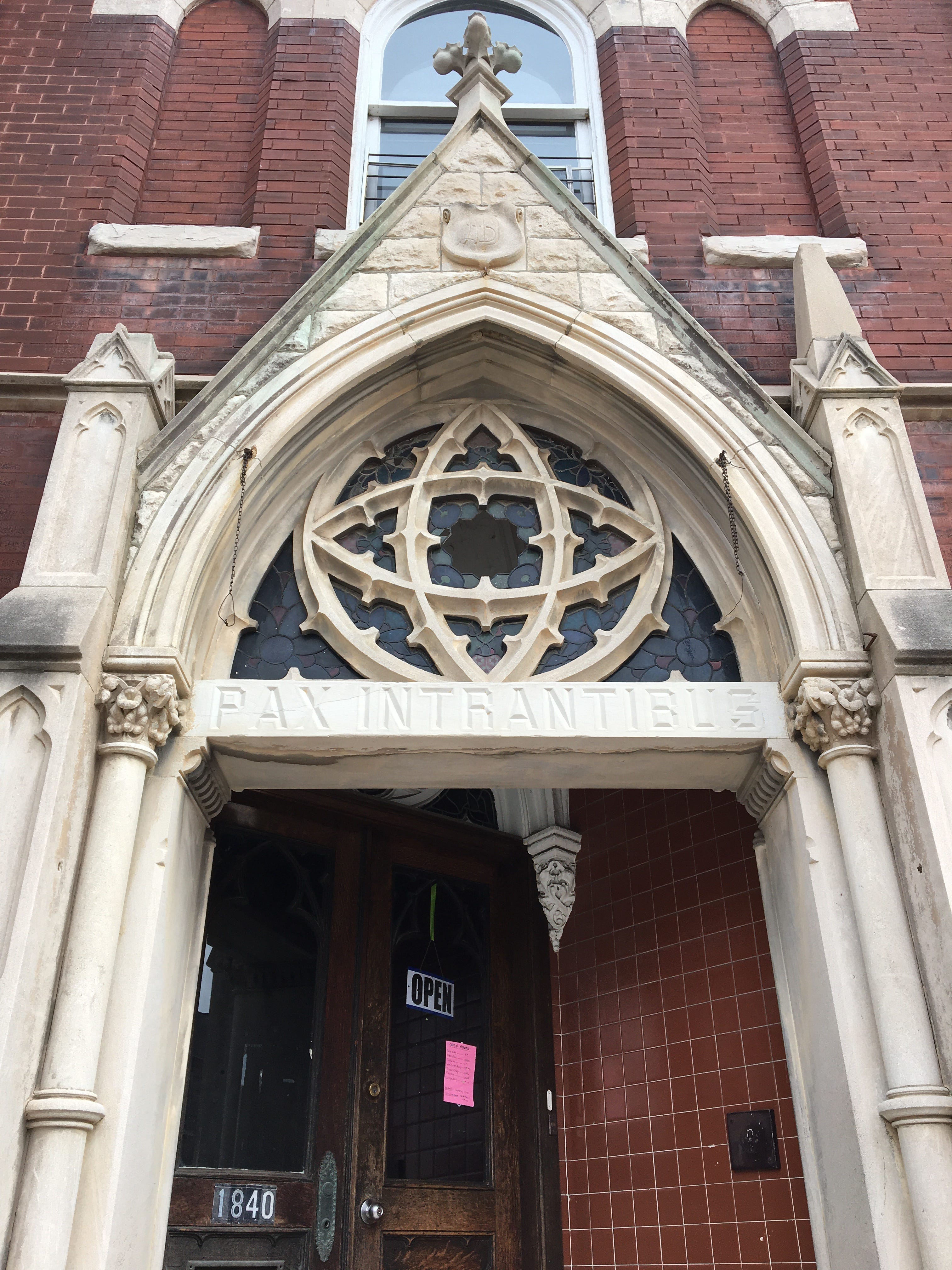
It was filled with people laughing and crying, hugging and fighting. I experienced it as a place of distress, a reminder of broken systems, and an uncomfortably close vision of desperate situations.
Grandmas, dads, and moms are always knocking on the door looking for sandwiches, fruit, bread, “anything you’ve got,” for themselves and a family. People come to Karen House in their neediness, asking for what is rightly theirs: food and shelter. They come smelling of smoke, alcohol, fresh air, goodness, loveliness and clothes that have weathered too many nights in the damp cold.
But, I also experienced Karen House as a space saturated with grace, brimming with possibility and shimmering with touchpoints of divinity. It is a place of nativity where God is being born to fill in the gaps. And, like the nativity, it was not glamorous, efficient or stable. It was messy.
I felt hope, what Emily Dickinson says is “the thing with feathers that perches in the soul and sings the tune without the words and never stops at all,” at Karen House.
I felt it in the mundanity of dishwashing and in the handing off of sandwiches amidst wafts of alcohol and drifts of frigid air. I felt it when I tossed out moldy bread, when I smelled the dankness of the nonperishable food room in the basement. I felt it when, despite being homeless and tired, a young mother and her young boy hoo-la-hoop together with an older woman and they laugh and laugh and laugh.
I felt it when I read in the house log, “Miss Sharon moved out today and donated her DVDs to the house.”
I felt it when I saw crew members just do what had to be done when toilets were breaking and wallets went missing and human feces had destroyed beds and chairs.
I felt hope because none of it had to be. The broken house, the crew members who chose to live there, who chose to get involved, the moldy excess of food, a dank room in the basement filled with giant cans of jelly, the guests who brought life with their laughs and their struggles and their DVDs. None of it had to be and yet it was.
Cardinal Avery Dulles, SJ wrote, “The Incarnation does not give us a ladder to climb out of the human condition. It gives us a drill that lets us burrow down into the heart of everything that is and, there, find it shimmering with divinity.”
Without romanticizing the harsh reality that this world heaps upon the poor and marginalized, Karen House helped me burrow into the heart of everything that is and find it shimmering with divinity.
In the Catholic tradition, we sometimes celebrate the liturgical feast days of holy buildings, as well as holy people. On November 9, for example, Catholics celebrate the Feast of the Dedication of the Lateran Basilica. Perhaps it is odd to celebrate a building. After all, it is just concrete and marble. But of course, for those who use them, we know that our respective houses of worship are sacred, they are places where extraordinary things happen and where extraordinary encounters take place.
As I have reflected about the sacredness of Karen House and all that has taken place within and because of it, I thought of this tradition of celebrating basilicas. It is a place of extraordinary encounters. With its duct-taped stained glass, overflowing clothes room, and a whiteboard that carries messages such as “Bed Bug count: 1” and “Jay graduated today!” alongside each other, Karen House points to another way humans can dwell together.
I am grateful to those who founded this house years ago. To those who have kept it alive through the years. To those who will bring it into a new chapter of hospitality.
At the risk of even more pious pap I will say that we ought to embrace and kiss the places where such persons have put their feet. It is indeed holy ground.
Loved this Billy - when last I was in St. Louis, for Phil & Julie Berkheimeier's wedding many years ago, I stayed at Karen House - no bed bugs, but plenty of love...